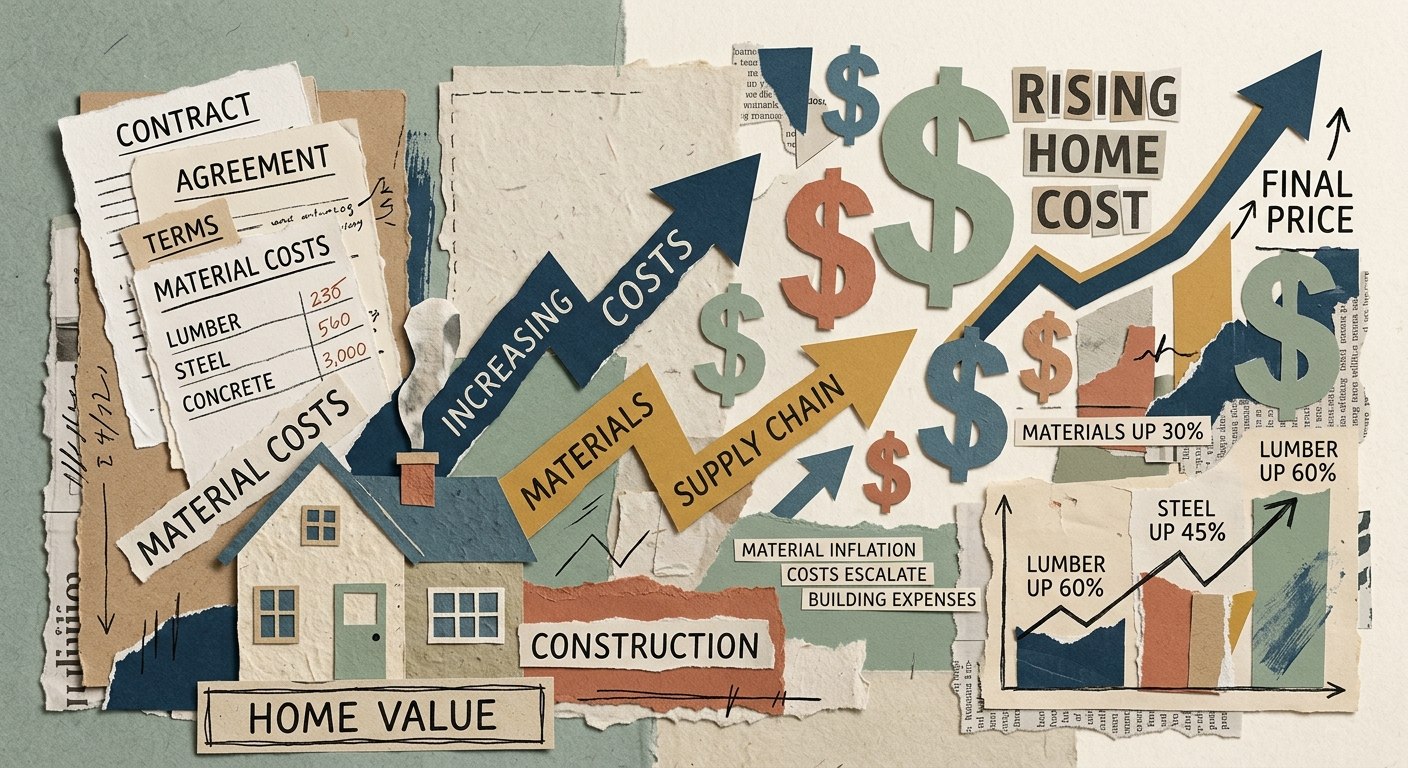
You found the ideal floor plan, picked the perfect lot, and toured the model home twice. The contract sitting between you and that home deserves the same attention you gave your kitchen finishes.
Builder contracts for new construction in Clark County sometimes include material escalation clauses. This language gives the builder the legal right to increase your purchase price before you reach closing. Most buyers sign these documents without knowing the clause is even there.
The text does not announce itself with a dramatic heading. It sits quietly within the fine print, making it easy to miss without a professional review.
A material escalation clause is contract language that allows a builder to raise the purchase price if specific material costs spike between signing and completion. These clauses became common after lumber prices surged more than 35 percent in 2021 and 2022, and they remain in many production builder contracts today. Asking whether the clause exists, what triggers it, and whether it is capped is the most reliable protection available to buyers before they sign.
The Mechanics of a Material Escalation Clause
A material escalation clause is a provision that allows a builder to increase the purchase price under certain economic conditions. It activates if the cost of building supplies rises significantly between contract signing and home completion.
The clause entered widespread use after lumber prices surged more than 35 percent a few years ago. Builders absorbed massive cost increases and responded by writing protective language into their agreements. Many of those clauses remain in place today.
The clause typically specifies a triggering threshold and may or may not include a firm price cap. Some are narrow and rarely triggered, while others are much broader in scope. The only way to know which version you are signing is to read the paperwork and ask direct questions.
Local Market Realities for Clark County Buyers
Through much of last year, many production builders in the Clark County market absorbed cost increases rather than passing them to buyers. That posture has officially shifted for regional developments.
Materials are repricing across multiple core categories. One local design center manager shared with our team that a significant price increase in engineered flooring was coming across the market.
The important distinction to understand is between voluntary upgrades and standard features. Say your contract includes a tile primary shower as a baseline standard item. A price increase in that material category can still reach your bottom line through an escalation provision.
The Producer Price Index tracks raw material costs that impact these price increases. It is often one of the earliest indicators that costs may be going up.
Erin Smiley, buyer’s agent and co-founder at New Construction Market Experts, tracks these contract clauses closely across Clark County communities. Her advice on the topic is straightforward.
“Back in 2021 and 2022, when lumber increased 35%, that’s where you’re going to see material escalation clauses. You have to ask: ‘We’re going under contract. This is my final locked-in price barring any changes to material.’ Because we sometimes have a material escalation clause, you need to know what that means. Maybe we’re not really seeing it right now, hard to say. Maybe in six months we will see it.” Erin Smiley, Buyer’s Agent and Co-Founder, New Construction Market Experts
Essential Contract Questions to Ask Before Signing
You may not be able to negotiate a material escalation clause completely out of a production builder contract. These are highly standardized documents, and most terms are not open to negotiation.
What is within your control is understanding exactly what you are agreeing to. Protection starts with one specific inquiry. You must ask if a material escalation clause exists, what triggers it, and if a cap applies. If the on-site agent cannot give you a clear answer, you need an independent advocate who can.
Marci Caputo, Managing Broker and co-founder of NCME, is direct about where buyers should focus during contract review.
“The first thing that comes to mind is dates, really honing in on every one of those dates, from when that earnest money is due to when you need to get into that design center appointment. And then the material cost escalation, reading the whole contract. Builders have their own contracts, and they’re a little more in favor of the builder or seller. That’s why we want to help guide you through those contracts. You want to make sure you really understand what you’re signing.” Marci Caputo, Managing Broker and Co-Founder, New Construction Market Experts
If you want an expert to walk you through a builder contract before signing, reach out to the NCME team to start the conversation.
Proactive Strategies of Prepared Homebuyers
Preparation is what helps buyers move through the new construction process with fewer surprises. You need to read the contract before signing. The advice of a buyer’s agent familiar with these contracts can help you understand the various clauses.
Informed buyers ask about material escalation clauses before falling in love with a specific layout. They understand that the builder’s on-site agent represents the seller’s interests exclusively.
New construction in Southwest Washington is exciting because inventory is available across a wide range of growing communities. Buyers can secure a home built to current energy codes, under warranty, and move-in ready without dealing with bidding wars.
Total Advocacy During Your Contract Review Period
A buyer’s agent in new construction does critical work that most buyers do not see until something goes wrong. Contract review is one of the clearest examples of this professional protection.
The builder’s on-site agent is not your legal or financial representative. Under NAR’s Code of Ethics and Standards of Practice, an agent represents the party they are explicitly hired to serve.
The builder hires the on-site agent to sell homes in that neighborhood. They may be incredibly helpful, but they are not looking out for your financial interests.
A buyer’s agent has read versions of these contracts across multiple regional builders. They know where escalation clauses tend to appear and what language to flag. They also know what questions to ask on your behalf.
Check our recent post to learn more about the value of having a buyer’s agent in new construction.
Common Questions About Material Escalation Clauses
Can a builder legally raise my price after I sign a new construction contract?
Yes, if the contract you signed includes a material escalation clause. These clauses are legally enforceable once signed. The clause typically specifies a triggering condition, such as a percentage increase in material costs. It may or may not include a cap on how much the price can rise. Reading the contract carefully before signing is your best protection.
Does a material escalation clause apply only to upgrades or also to standard features?
Material escalation clauses can apply to standard materials included in the base price, not just to upgrades selected at the design center. If a standard feature uses a material that increases in cost, the clause may still apply. This is a key reason to ask about it, regardless of how many upgrades you plan to add.
What is the cap on a material escalation clause, and does every contract have one?
Some builder contracts include a cap, which represents the maximum percentage by which the price can increase due to changes in material costs. Others do not include a cap at all. Asking specifically whether a cap exists and what that ceiling is should be part of your review before signing. If no cap exists, there is no contractual limit on how much the price can increase.
Should I try to negotiate a material escalation clause out of the contract?
With most production builders, the standard contract is not significantly negotiable. The more realistic goal is to understand exactly what you are agreeing to. What triggers the clause, whether there is a cap, and under what conditions it would apply are all questions worth getting answered in writing. A buyer’s agent with new construction experience can help you interpret the language and ask the right questions before you commit.
How do I know if a builder in Clark County uses a material escalation clause?
The only reliable way to know is to read the purchase agreement before signing and ask the builder’s representative directly. Clause language and terminology vary between builders. Reading the actual contract matters more than asking a general question about the builder’s policy.
What other contract dates and deadlines should I pay attention to besides the escalation clause?
Builder contracts include several time-sensitive provisions beyond material escalation. Earnest money due dates, design center appointment deadlines, financing contingency windows, and inspection periods all carry real consequences if missed. Missing a design center deadline, for example, can limit your selections or lead the builder to lock in standard finishes on your behalf.
What happens to my earnest money if a material escalation clause raises the price beyond what I can afford?
It depends entirely on the contract language. Some contracts allow buyers to exit without penalty if a price increase exceeds a defined threshold. Others do not. Whether earnest money is refundable in this scenario is something to confirm before signing. A buyer’s agent can identify whether your contract includes any exit provisions tied to material cost increases.
Before You Sign a Builder Contract in Clark County, Talk to Someone Who Reads Them Every Day
New construction in Southwest Washington represents a significant real estate opportunity for today’s buyers. You receive more inventory choices, comprehensive new-build warranties, and energy-efficient construction standards. The purchase contract sitting between you and that opportunity deserves careful professional attention before you pick up the pen.
The NCME team reviews builder documents with buyers across Clark County every week. We know which sections carry the most risk, what questions to ask, and how to help you enter the transaction prepared. Connect with the NCME team before you sign any paperwork.
ABOUT THE EXPERT
Marci Caputo is a Managing Broker and co-founder of New Construction Market Experts (NCME) in Vancouver, WA, with 25+ years of real estate experience. She specializes in connecting buyers with new construction homes across SW Washington, making the process buyer-centric, efficient, and economically advantageous.