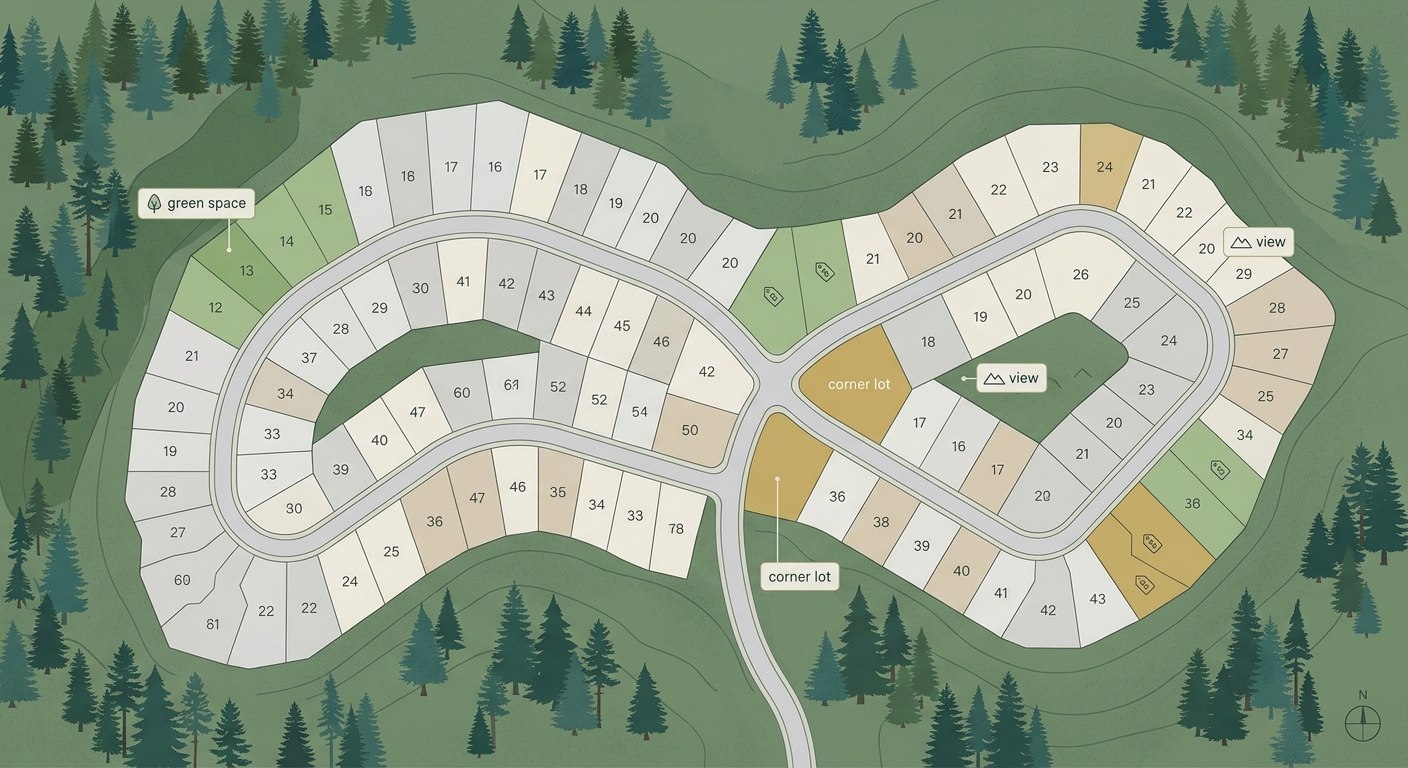
Lot premiums in Clark County’s new construction follow a clear logic once you know what to look for. In most communities across Clark County and SW Washington, roughly 80% of available lots carry no premium. The remaining 20% come with an added price tag. Whether that price tag reflects real value depends on factors buyers may not immediately notice when reviewing a site map.
Understanding what drives lot premiums is one of the clearest ways to make a more confident new construction decision in Clark County.
Marci Caputo is a Managing Broker and co-founder of New Construction Market Experts (NCME) in Vancouver, WA, with 25+ years of real estate experience. She specializes in connecting buyers with new construction homes across SW Washington, making the process buyer-centric, efficient, and economically advantageous.
The Real Reasons Builders Add Lot Premiums in Clark County
Clark County builders are not adding these fees arbitrarily. They follow a pricing logic tied to specific, observable lot characteristics.
The most common premium drivers are privacy, elevated views, lot size, and corner positioning. Corner lots have neighbors on only two sides, not three. That creates a quieter side yard and a sense of space that is difficult to find in a production community.
As relocation to Southwest Washington increases, demand for these lots is growing. However, some of the top features are also scarce. If you want one of those backing lots, expect to pay for it. Corner lots and view lots are in a different category, and each comes with trade-offs worth understanding before you sign.
View Lots in Clark County Come With a Drainage Advantage
In Clark County, view lots are usually on elevated land. This elevation is important for several reasons that buyers might not think of right away.
Elevated lots generally drain better than flat lots. This is especially helpful during the rainy season in the Pacific Northwest. Flat lots in Ridgefield, where clay soil does not absorb water well, can have drainage issues. They can hold water in ways that require additional drainage planning.
Erin Smiley, buyer’s agent and co-founder at NCME, evaluates drainage as a key point on any lot, premium or not.
“With the Northwest, you really have to be so in tune and so proficient at drainage. Sometimes the lots that pose the biggest drainage issue are flat, the soil is clay, and water doesn’t seep in; it just moves out. With your view lots, that means you probably have an elevated lot where there’s going to be a drainage system in the back that’s really multiple drainage systems taking the water away. It’s all about taking the water away from the home.” – Erin Smiley, Buyer’s Agent and Co-Founder, New Construction Market Experts
The right buyer’s agent connects the drainage conversation directly to the premium price. For more on what to evaluate before choosing a community, our neighborhood selection checklist covers the questions most buyers overlook.
A Budget-First Approach to the Lot Premium Decision
The decision becomes clearer when it flows from the budget outward rather than from the lot inward. Starting with what a premium adds to the monthly payment, not just the purchase price, helps buyers stay grounded when evaluating a specific lot.
Marci Caputo co-founded NCME to help buyers stay focused on what matters most during the new construction process. Her approach starts with helping buyers clarify their priorities before the premium decision becomes emotional.
“Usually, folks are quite animated, and they’re very happy to tell you that they want a green space. But it’s really about your budget. With the communities and the lots that had green space or views, that’s probably about 20% of your lots, so most lots do not have these premiums. If it’s something you’re going to turn around and sell, you’ll definitely see that as a plus for resale purposes. And if you can’t afford it, then maybe you’re putting Leyland cypress trees to give you some privacy. It just really depends.” – Marci Caputo, Managing Broker / Co-Founder, New Construction Market Experts
That last point is practical. A property owner can enhance privacy with landscaping. If a view isn’t there, you don’t have any options to create one. The key question for most buyers is whether they can add the premium feature later, or if it is unique to that lot.
If you are not sure whether a specific lot’s premium reflects real value or a builder’s pricing strategy, talk to the NCME team about the community you’re evaluating before you write the offer.
Lot Premiums Worth Paying vs. Ones Worth Negotiating
A lot of premium makes sense when the feature it buys is durable, meaningful to daily life, and likely to be valued at resale. Green space backing, elevated views with clear sightlines, and larger corner footprints tend to retain their appeal over time.
A premium may warrant closer scrutiny when builders apply it broadly across a community without meaningful differentiation. A buyer’s advocate who has reviewed the community’s full premium structure can identify this.
The resale angle matters too. Lots with green space backing and unobstructed views consistently carry marketing advantages at resale. The same might not be true for privacy features.
Understanding builder incentive structures is closely related to evaluating lot premiums. Our article on builder incentives in new construction breaks down how builders price value into the deal and where negotiating opportunities may exist.
Lot Premium Protections in Your New Construction Purchase Agreement
When a lot premium is included in your purchase agreement, it is typically listed as a separate line item above the home’s base price. That matters for a few reasons.
First, the premium is part of the financed amount if you are borrowing. It will affect your loan-to-value ratio (LTV) and, depending on the lender, may influence how your appraisal is structured. The CFPB’s mortgage resources provide a useful starting point for borrowers.
Second, premium pricing is set by the builder and reflects the builder’s assessment of that lot’s relative value within the community. Builders use premium tiers strategically. A buyer’s advocate familiar with the community’s pricing history can help interpret whether a listed premium aligns with the lot’s features.
Lot Premium FAQs for Clark County Buyers
What is a lot premium in Clark County’s new construction?
A lot premium is an additional charge a builder adds to the base price of a home based on the lot’s specific characteristics. Common premium drivers in Clark County include backing to green space, elevated views, corner positioning, and larger lot size. In most local communities, roughly 80% of lots carry no premium.
Are lot premiums negotiable with Clark County builders?
Lot premiums are sometimes negotiable, particularly in slower market conditions or when a community has been on the market for an extended period. Builders are generally less flexible on premiums for high-demand lots. A buyer’s agent experienced in new construction negotiations can assess the builder’s flexibility before you make an offer.
Do lot premiums increase resale value in Southwest Washington?
Lots with durable features such as green space backing, unobstructed views, or a corner footprint tend to support stronger resale pricing. Buyers who purchase a premium lot for lifestyle reasons often see that value reflected when they sell.
Is a corner lot worth the premium in a new construction community?
Corner lots offer neighbors on only two sides. That typically means a quieter side yard, more natural light, and a sense of openness that standard interior lots lack. The trade-off is that corner lots sometimes have less backyard privacy and more pedestrian activity on two street frontages. Whether the premium is justified depends on the lot layout and the buyer’s priorities.
What is the difference between a builder’s on-site agent and a buyer’s agent?
The builder’s on-site agent represents the builder’s interests, not the buyer’s. Their role is to facilitate the builder’s sale process. A buyer’s agent with experience in new construction represents the buyer’s interests. They evaluate premium structures, negotiate incentives, and provide independent guidance.
How do I evaluate whether a Clark County lot premium is priced fairly?
The most reliable approach is to have a buyer’s advocate review the community’s full premium structure before you sign. Your buyer’s agent can compare premiums across lots within the community and assess whether the feature justifies the price difference.
Understanding Lot Premiums Is Part of Getting the Deal Right
Some lot premiums retain their value over time, while others warrant closer review. Buyers who know the difference can negotiate from a stronger position. That insight often leads to better overall value.
Our team helps buyers break down premium structures and identify where negotiation may be possible. We bring knowledge and context that buyers often miss. Connect with NCME before you agree to a lot premium.